ASEAN-China Media and Think Tank Forum 2025: Strengthening ASEAN-China Cooperation
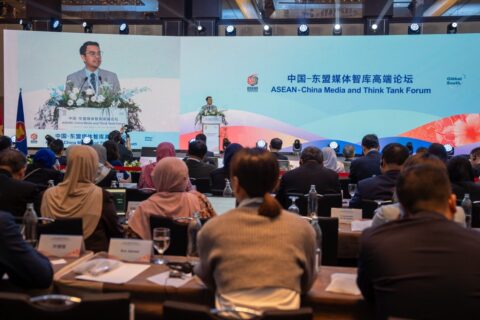
The ASEAN–China Media and Think Tank Forum 2025 was successfully convened on 11 April 2025 in Kuala Lumpur, Malaysia. The forum marked a significant milestone in underscoring the role of media and think tanks as vital bridges for strengthening longstanding friendship, enhancing mutual understanding, and advancing deeper ASEAN–China cooperation.
Co-hosted by Xinhua News Agency and the Malaysian National News Agency (BERNAMA), with the Centre of Regional Strategic Studies (CROSS) honoured to serve as one of the co-organisers, the forum brought together more than 250 delegates from over 160 media organisations, think tanks, government institutions, and industry bodies across China and all ASEAN member states.

Carrying the theme “Strengthening ASEAN-China Cooperation,” the event provided a dynamic platform for participants to deepen understanding, address emerging regional challenges, and craft a shared vision for the future of ASEAN-China relations.

In his opening address, Deputy Prime Minister Dato’ Seri Fadillah Yusof reaffirmed Malaysia’s commitment, particularly as ASEAN Chair, to promoting fair, open, and inclusive economic development across the region. He underscored the significance of the ASEAN-China FTA 3.0 Upgrade Protocol, which is expected to accelerate trade, investment, and long-term integration.
He also highlighted the vital role of media and think tanks in shaping informed policymaking and bridging perspectives in an increasingly complex global landscape.


Lyu Yansong, Editor-in-Chief of Xinhua News Agency, emphasised the importance of deepening partnerships in artificial intelligence, regional research, media collaboration, and cultural exchange. He stressed that building shared narratives is essential for fostering peace, trust, and a stronger sense of community between ASEAN and China.

Malaysia’s Minister of Communications, Datuk Fahmi Fadzil, encouraged ASEAN and China to broaden their collaboration beyond traditional sectors such as trade and infrastructure. He advocated people-centred journalism, inclusive digital transformation, and ensuring media accessibility, particularly in remote and and underserved communities.
“As technology reshapes the media landscape, accessibility must remain a central principle,” he noted.


CROSS Vision for Regional AI Cooperation and Talent Development
During the forum session, YB Lee Chean Chung, Chairman of CROSS and Member of Parliament for Petaling Jaya, delivered a forward-looking keynote calling for ASEAN and China to transition from dialogue to practical and measurable cooperation in artificial intelligence.

He proposed several strategic initiatives, including establishing joint ASEAN-China AI research centres, developing cross-border innovation hubs to drive collaboration, investing in STEM and AI talent development, and expanding youth exchanges and fellowship programmes to nurture regional leaders.
YB Lee emphasised the need for think tanks and media institutions to lead in shaping ethical and responsible narratives in the AI era.

“Let AI be a bridge between nations, sectors, and people,” he said.
“Together, ASEAN and China can set a global example of AI development that is smart, fast, and fair—bringing hope, justice, and inclusion to all.”

ASEAN-China Seminar on Super-sized Markets & Connectivity
Held in conjunction with the forum, the ASEAN-China Seminar on Super-sized Markets & Connectivity, co-organised by CROSS, provided deeper insights into changing regional economic and technological landscapes.
Dato’ Dr. Lee Boon Chye, Advisor of CROSS and Chairman of Bioeconomy Corporation, delivered key observations on the evolving ASEAN-China economic relationship.
He highlighted,
“Currently, 60% of ASEAN-China trade enjoys zero tariffs. With the upgraded trade agreement, this percentage will continue to rise. Amid growing global trade protectionism, unity between ASEAN and China is crucial.”

Dr. Lee also underscored China’s accelerating leadership in artificial intelligence, noting that China’s AI patent applications in 2024 exceeded those of the rest of the world combined.
With shifting global education dynamics, he emphasised China’s growing role as a destination for advanced research, “In the past, our brightest minds went West for PhDs and research. Now, with rising Western restrictions, it is time to reverse the flow and look East.”

The seminar also featured insights from distinguished speakers including Dato’ Ong Chong Yi (BRICAP), Zhu Jiaqi (Shenergy Group), and Emory Qi Feng (SAIC Motor Malaysia). Moderated by Gao Pan (CEIS Shanghai), the session explored regional connectivity, market integration, and digital-driven growth.

The ASEAN-China Media and Think Tank Forum 2025 reaffirmed a strong regional commitment to deepening cooperation in media development, digital innovation, research linkages, and people-to-people connectivity.

With participation from leading policymakers, scholars, and media professionals, the forum strengthened collective resolve to build a resilient, interconnected, and future-ready ASEAN-China community.

CROSS is honoured to have co-hosted this milestone event and remains committed to advancing strategic dialogue, promoting research excellence, and supporting initiatives that drive peace, development, and technological progress throughout the region.


𝐂𝐑𝐎𝐒𝐒–𝐗𝐢𝐧𝐡𝐮𝐚 𝐌𝐨𝐔 𝐅𝐞𝐚𝐭𝐮𝐫𝐞𝐝 𝐀𝐦𝐨𝐧𝐠 𝟑𝟏 𝐌𝐚𝐥𝐚𝐲𝐬𝐢𝐚-𝐂𝐡𝐢𝐧𝐚 𝐀𝐠𝐫𝐞𝐞𝐦𝐞𝐧𝐭𝐬 𝐚𝐧𝐝 𝐂𝐨𝐨𝐩𝐞𝐫𝐚𝐭𝐢𝐨𝐧 𝐎𝐮𝐭𝐜𝐨𝐦𝐞𝐬 𝐃𝐮𝐫𝐢𝐧𝐠 𝐏𝐫𝐞𝐬𝐢𝐝𝐞𝐧𝐭 𝐗𝐢’𝐬 𝐕𝐢𝐬𝐢𝐭

During the forum, the Centre of Regional Strategic Studies (CROSS) and Xinhua News Agency signed a Think Tank Exchange and Cooperation Agreement, represented respectively by YB Lee Chean Chung, Chairman of CROSS, and Mr. Lv Yansong, Editor-in-Chief of Xinhua News Agency. This cooperation outcome was officially included in the list of bilateral cooperation achievements exchanged during the state visit of H.E. Xi Jinping, President of the People’s Republic of China, to Malaysia.

Notably, among the 31 memoranda of understanding (MoUs) exchanged between the two countries, only three were non-government-to-government (non-G2G) agreements, with CROSS honoured to be one of the participating institutions. This recognition underscores the growing role of independent think tanks in advancing regional cooperation and strengthening people-to-people diplomacy.


Following the signing, CROSS and Xinhua will actively promote mutual visits and personnel exchanges, co-organise bilateral and multilateral consultations, research collaborations, forums, and training programmes, and jointly undertake collaborative research projects and academic publications. These initiatives aim to further deepen media–think tank cooperation and generate tangible contributions to regional development.