
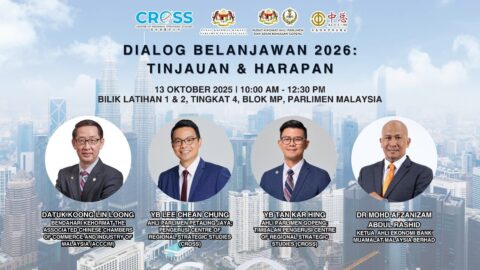
The Budget 2026 Dialogue: Reflections and Aspirations was held on 13th October 2025 at the Parliament of Malaysia as a strategic platform bringing together Members of Parliament, economists, industry leaders, business associations, and policy think tanks to discuss Malaysia’s economic direction ahead of the upcoming national budget.


Organized by the Centre of Regional Strategic Studies (CROSS) and co-organized by the Petaling Jaya Parliament Office, Gopeng Parliament Office, and The Associated Chinese Chambers of Commerce and Industry of Malaysia (ACCCIM), focused on key fiscal challenges, structural reforms, and strategies to strengthen Malaysia’s economic resilience amid global uncertainties.

Participants raised a range of issues and proposals, including the expansion of the Sumbangan Asas Rahmah (SARA) programme to rural mini-markets, tax exemptions for the construction sector, and the establishment of a One-Stop SME Portal to streamline access to business information and financial assistance.


Concerns over communication gaps between the government and industry players were also discussed, along with calls for greater transparency and efficiency in policy implementation. Other suggestions included introducing a Lemon Law for vehicle service rights, providing more affordable rental housing, and expanding the MyKasih Programme to include school supplies and educational needs.

During the dialogue, Dr. Mohd Afzanizam Abdul Rashid, Chief Economist of Bank Muamalat Malaysia Berhad, provided a macroeconomic perspective on Malaysia’s fiscal and economic outlook.
He noted that Malaysia has made encouraging progress in fiscal consolidation, with a gradual reduction in the fiscal deficit helping to stabilise government debt growth and strengthen investor confidence. However, he cautioned that the pace of further improvement remains sensitive to external risks, including global economic headwinds and policy uncertainties in major economies, underscoring the need for continued prudence and policy flexibility.

Dr. Afzanizam welcomed several measures under Budget 2026 that support economic resilience and structural transition, including the expansion of financing guarantees for SMEs, tax incentives for food security projects, and the extension of the Green Technology Financing Scheme (GTFS 5.0). He emphasised that these initiatives could help crowd in private investment, support industrial upgrading, and strengthen medium- to long-term growth prospects.
He also highlighted structural inefficiencies in the housing and labour markets, stressing that stagnant wages and rising living costs must be addressed through targeted reforms. He noted that reinstating GST could strengthen government revenue through a more transparent and effective taxation system.
In conclusion, he underscored that economic and institutional reform is a long-term endeavour. The government’s role, he argued, should gradually shift from direct market participation towards facilitation, creating a more efficient, transparent, and competitive environment that enables the private sector to drive sustainable and inclusive growth.

Datuk Koong Lin Loong, Honorary Treasurer of the Associated Chinese Chambers of Commerce and Industry of Malaysia (ACCCIM), commended Budget 2026 as a balanced, pragmatic and forward-looking budget that adopts a moderate yet proactive approach. He noted that the budget is anchored on four key objectives: strengthening economic resilience and inclusive growth; driving high-value investment and technological innovation; creating employment opportunities through human capital development and TVET; and ensuring long-term fiscal and social sustainability.
He welcomed the government’s commitment to fiscal discipline, particularly the plan to reduce the fiscal deficit from 3.8% in 2025 to 3.5% in 2026, which reflects a serious effort to maintain macroeconomic stability while preserving space for strategic investments and long-term development.

Datuk Koong emphasised that ACCCIM strongly supports the measures aimed at empowering micro, small and medium enterprises (MSMEs), which account for more than 97% of Malaysia’s business ecosystem. Key initiatives welcomed include the RM50 billion allocation for MSME financing through low-interest loans, microfinancing and credit guarantees under SJPP; an additional 50% tax deduction for MSMEs investing in artificial intelligence and cybersecurity training recognised by the National Industry AI Council (NAICI); the expansion of double tax deductions for scholarships to professional fields such as ICT, engineering, accounting and finance; and the increase of the Market Development Grant (MDG) to RM60 million to strengthen export capabilities. ACCCIM also proposed raising the lifetime MDG claim ceiling to RM500,000 to support long-term export growth.
He further welcomed the stamp duty exemption for employment contracts with salaries of up to RM3,000, which helps reduce hiring costs for smaller firms, as well as the continuation of incentives for agricultural automation, MyHIJAU-certified green investments, and support for local manufacturing technologies to enhance productivity and competitiveness.

At the same time, Datuk Koong highlighted several areas for improvement. These include revising the income threshold for the preferential 15% SME tax rate, which is currently capped at RM150,000, to improve cash flow and reinvestment capacity; simplifying financing application procedures and accelerating approval timelines to reduce bureaucratic delays; and enhancing the effectiveness of TVET spending by focusing on curriculum quality, instructor capacity, soft skills development, and modern training facilities.

Overall, the Budget 2026 Dialogue successfully served as a constructive platform for multi-sectoral engagement and policy reflection. Key takeaways include the need to strengthen fiscal fundamentals and subsidy efficiency, enhance productivity and innovation within the private sector, promote green investment and digitalisation; and ensure inclusive participation in national economic development.


